Press 2003
Interview with “The Palette”
Magazine cover · 2003 (Spring)
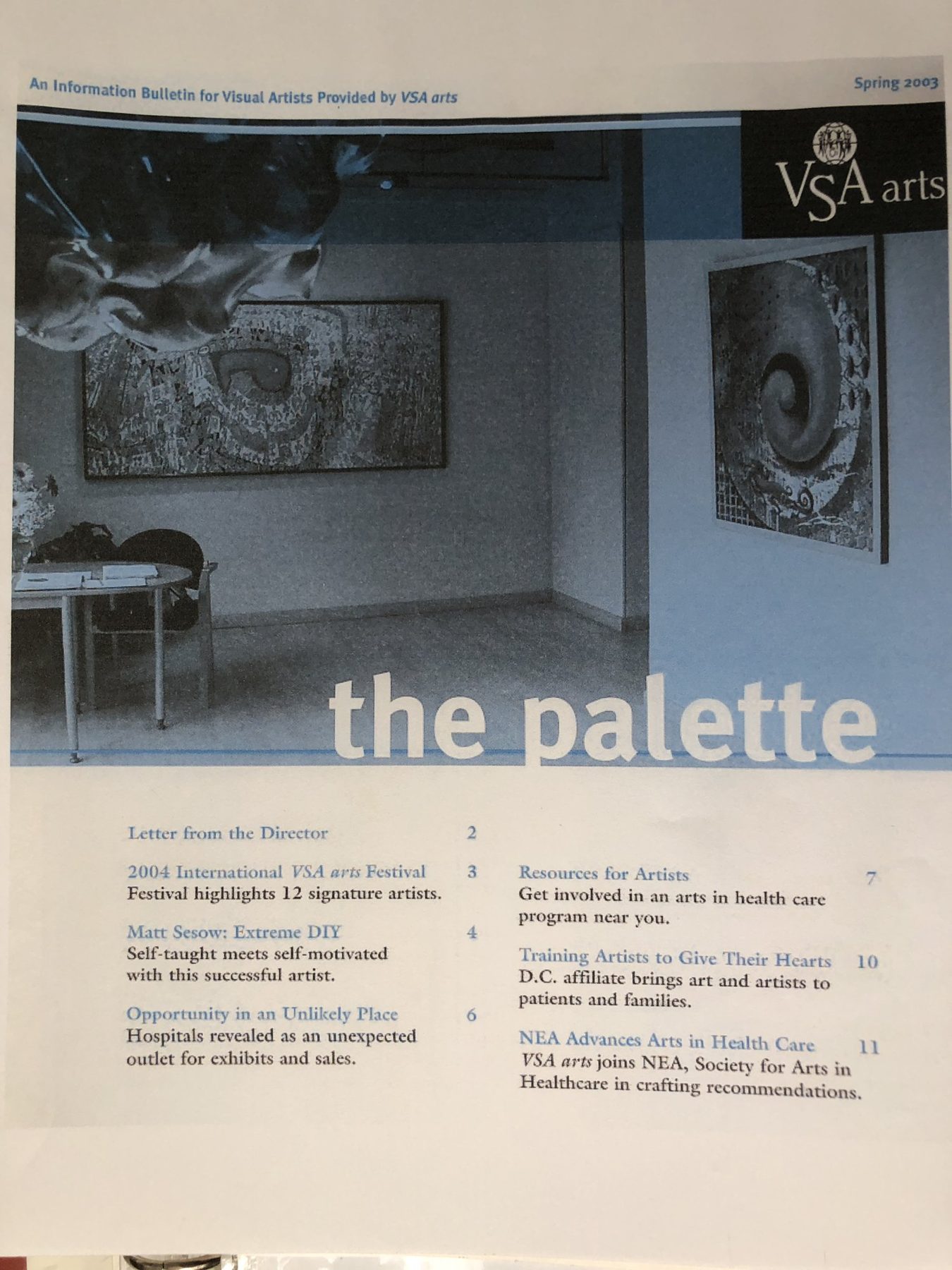
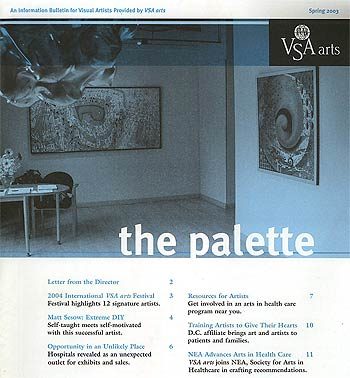
the palette, Spring 2003 — cover and contents ("Matt Sesow: Extreme DIY," page 4)
the palette — An Information Bulletin for Visual Artists Provided by VSA arts
Click a page to open it — scroll or pinch to zoom, drag to move.
Full text
Photographed by Matt Sesow from his press packets, October 18, 2026; text transcribed from the photos by Claude.
[Cover] An Information Bulletin for Visual Artists Provided by VSA arts — Spring 2003 — the palette
Contents:
Letter from the Director — 2
2004 International VSA arts Festival — 3. Festival highlights 12 signature artists.
Matt Sesow: Extreme DIY — 4. Self-taught meets self-motivated with this successful artist.
Opportunity in an Unlikely Place — 6. Hospitals revealed as an unexpected outlet for exhibits and sales.
Resources for Artists — 7. Get involved in an arts in health care program near you.
Training Artists to Give Their Hearts — 10. D.C. affiliate brings art and artists to patients and families.
NEA Advances Arts in Health Care — 11. VSA arts joins NEA, Society for Arts in Healthcare in crafting recommendations.
[Page 4]
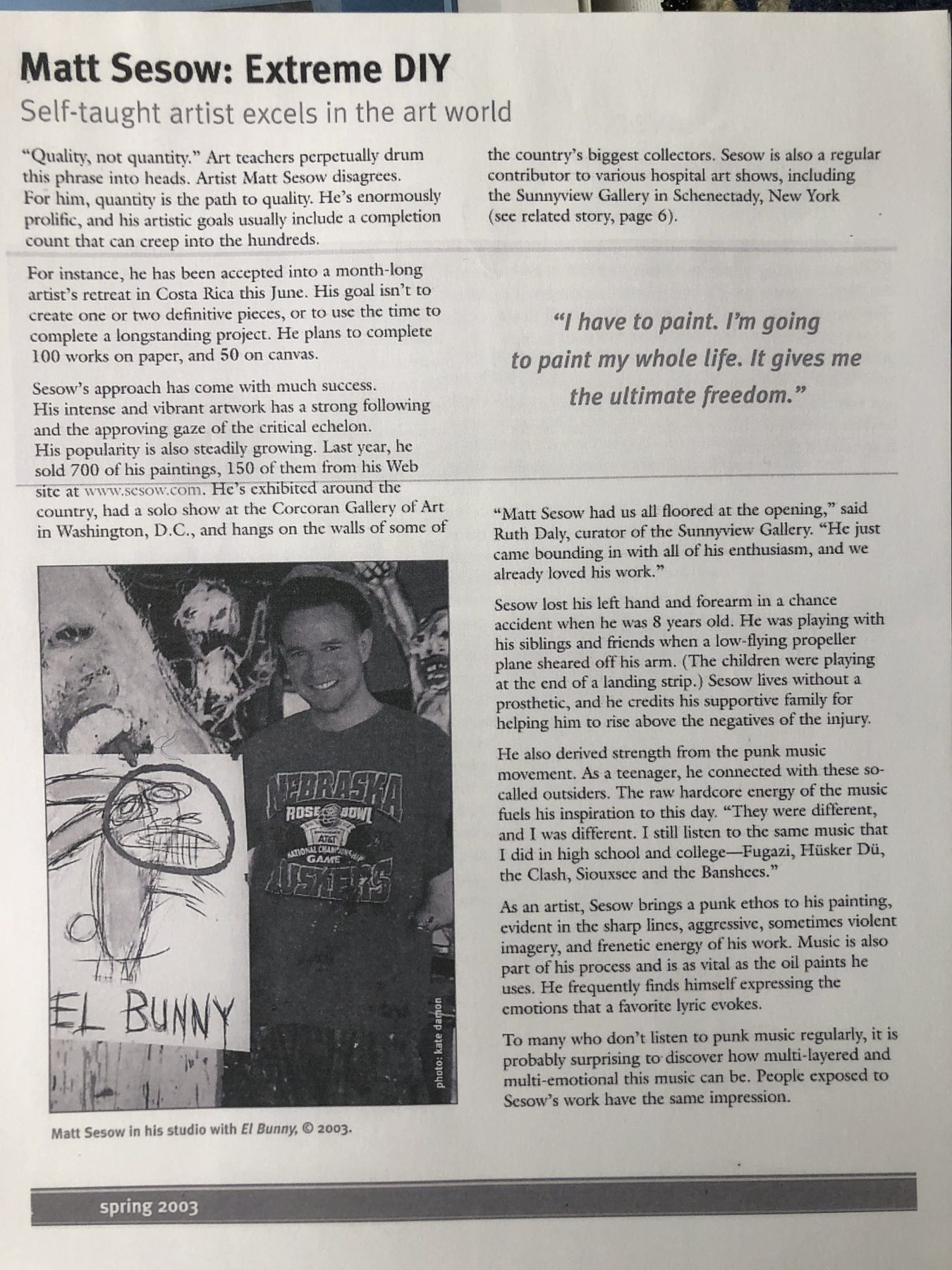
Matt Sesow: Extreme DIY
Self-taught artist excels in the art world
"Quality, not quantity." Art teachers perpetually drum this phrase into heads. Artist Matt Sesow disagrees. For him, quantity is the path to quality. He's enormously prolific, and his artistic goals usually include a completion count that can creep into the hundreds.
For instance, he has been accepted into a month-long artist's retreat in Costa Rica this June. His goal isn't to create one or two definitive pieces, or to use the time to complete a longstanding project. He plans to complete 100 works on paper, and 50 on canvas.
Sesow's approach has come with much success. His intense and vibrant artwork has a strong following and the approving gaze of the critical echelon. His popularity is also steadily growing. Last year, he sold 700 of his paintings, 150 of them from his Web site at www.sesow.com. He's exhibited around the country, had a solo show at the Corcoran Gallery of Art in Washington, D.C., and hangs on the walls of some of the country's biggest collectors. Sesow is also a regular contributor to various hospital art shows, including the Sunnyview Gallery in Schenectady, New York (see related story, page 6).
"I have to paint. I'm going to paint my whole life. It gives me the ultimate freedom."
"Matt Sesow had us all floored at the opening," said Ruth Daly, curator of the Sunnyview Gallery. "He just came bounding in with all of his enthusiasm, and we already loved his work."
Sesow lost his left hand and forearm in a chance accident when he was 8 years old. He was playing with his siblings and friends when a low-flying propeller plane sheared off his arm. (The children were playing at the end of a landing strip.) Sesow lives without a prosthetic, and he credits his supportive family for helping him to rise above the negatives of the injury.
He also derived strength from the punk music movement. As a teenager, he connected with these so-called outsiders. The raw hardcore energy of the music fuels his inspiration to this day. "They were different, and I was different. I still listen to the same music that I did in high school and college—Fugazi, Hüsker Dü, the Clash, Siouxsee and the Banshees."
As an artist, Sesow brings a punk ethos to his painting, evident in the sharp lines, aggressive, sometimes violent imagery, and frenetic energy of his work. Music is also part of his process and is as vital as the oil paints he uses. He frequently finds himself expressing the emotions that a favorite lyric evokes.
To many who don't listen to punk music regularly, it is probably surprising to discover how multi-layered and multi-emotional this music can be. People exposed to Sesow's work have the same impression.
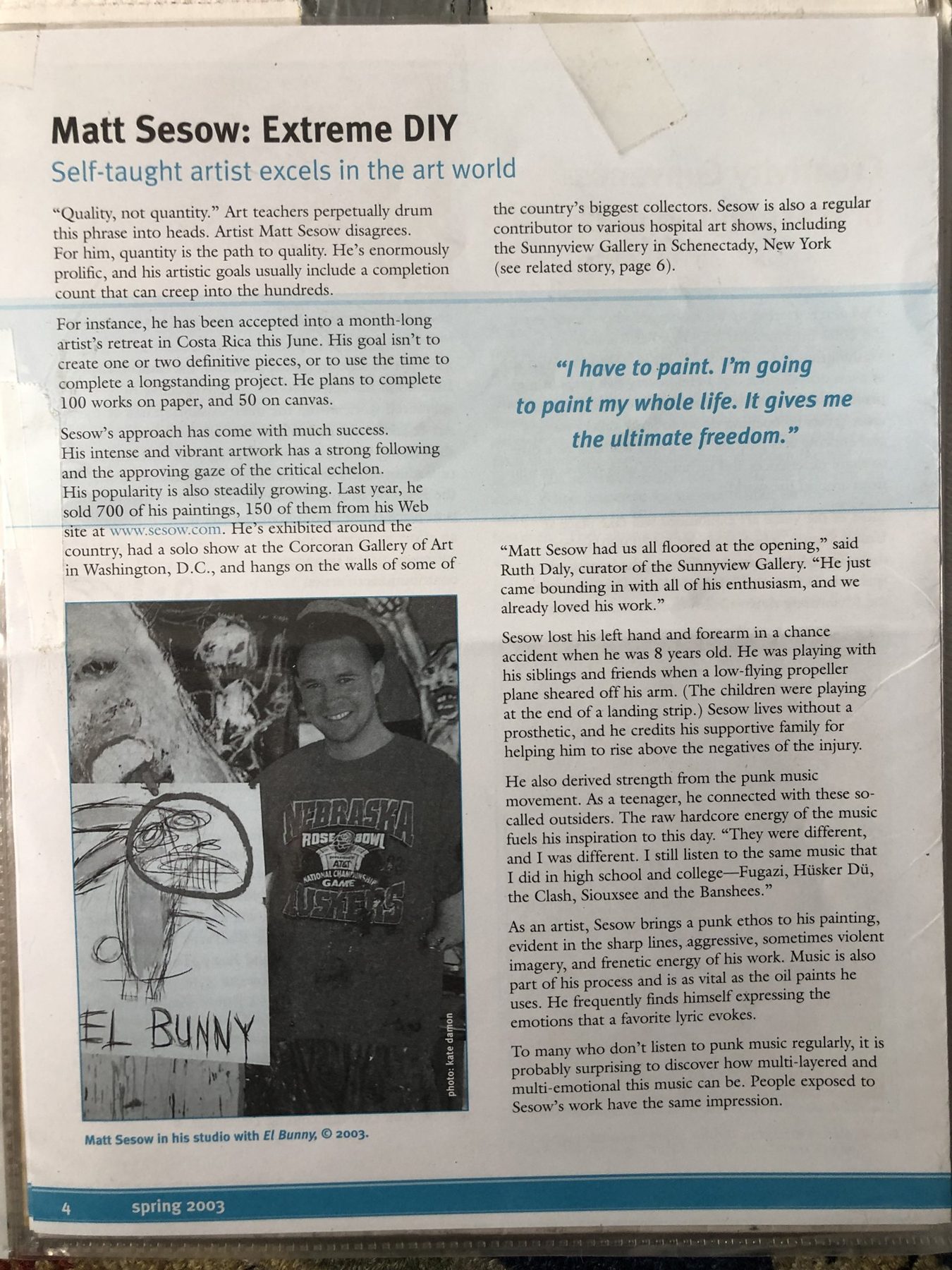
[Photo caption:] Matt Sesow in his studio with El Bunny, © 2003. — photo: kate damon
[Page 5]
Like a two-and-a-half minute punk song, Sesow strives to be utterly in the moment while he paints. It's why quantity is the path to quality for him. He tries to express himself with utter purity through his paints and pastels, then move on to the next work almost immediately. Sesow spends at least 6 –8 hours every day painting in his apartment/studio. As the day progresses, the paintings encircle him. He'll adjust a line or an element in each, take a feature from a later work and incorporate it into one of the day's first pieces. Not every piece results in a finished product, but it's all part of the process for Sesow.
A strong part of the punk rock movement is the DIY philosophy. DIY means "do it yourself," and Sesow ascribes to this minimalist self-sufficient philosophy as well. He is entirely self-taught and continues to set his own personal goals as a painter without the help of any professional training. (To study admired painters, he takes full advantage of the National Gallery and the Hirshhorn Museum down the street from his Washington, D.C. apartment.)
"I'm schooling myself about my work and color and all of it," said Sesow. "I'm a very Type A person. I'm a perfectionist. I'm trying to get to a point where I'm really expressing myself."
"I set a lot of goals for myself. I want to do 50,000 paintings before I die. I want to be hung in MoMA. I want to be recognized as someone who did something different."
His work has evolved steadily since the night he first picked up a paintbrush, with much serendipity, over ten years ago. To impress a girl he liked, he gamely started painting with her one night for fun. He surprised everyone and was hooked immediately. He became utterly dedicated to painting. And she became his wife.
When Sesow first started painting, his pieces were almost exclusively related to his then 20-year-old injury. He realizes now that as well-adjusted as he'd thought he'd been, he had much inside of him that needed to come out.
"It allowed me to express so much of what I didn't even realize I'd bottled up for so long," he said. "I really healed through the painting; I just painted endless works dealing with the accident."
He also realized that trauma was always going to be a focal point of his work.
"Trauma is vital to catharsis, knowledge, and self-learning," said Sesow. The images Sesow paints might alarm some, but in most cases, the painting is about growth through trauma, not trauma for trauma's sake.
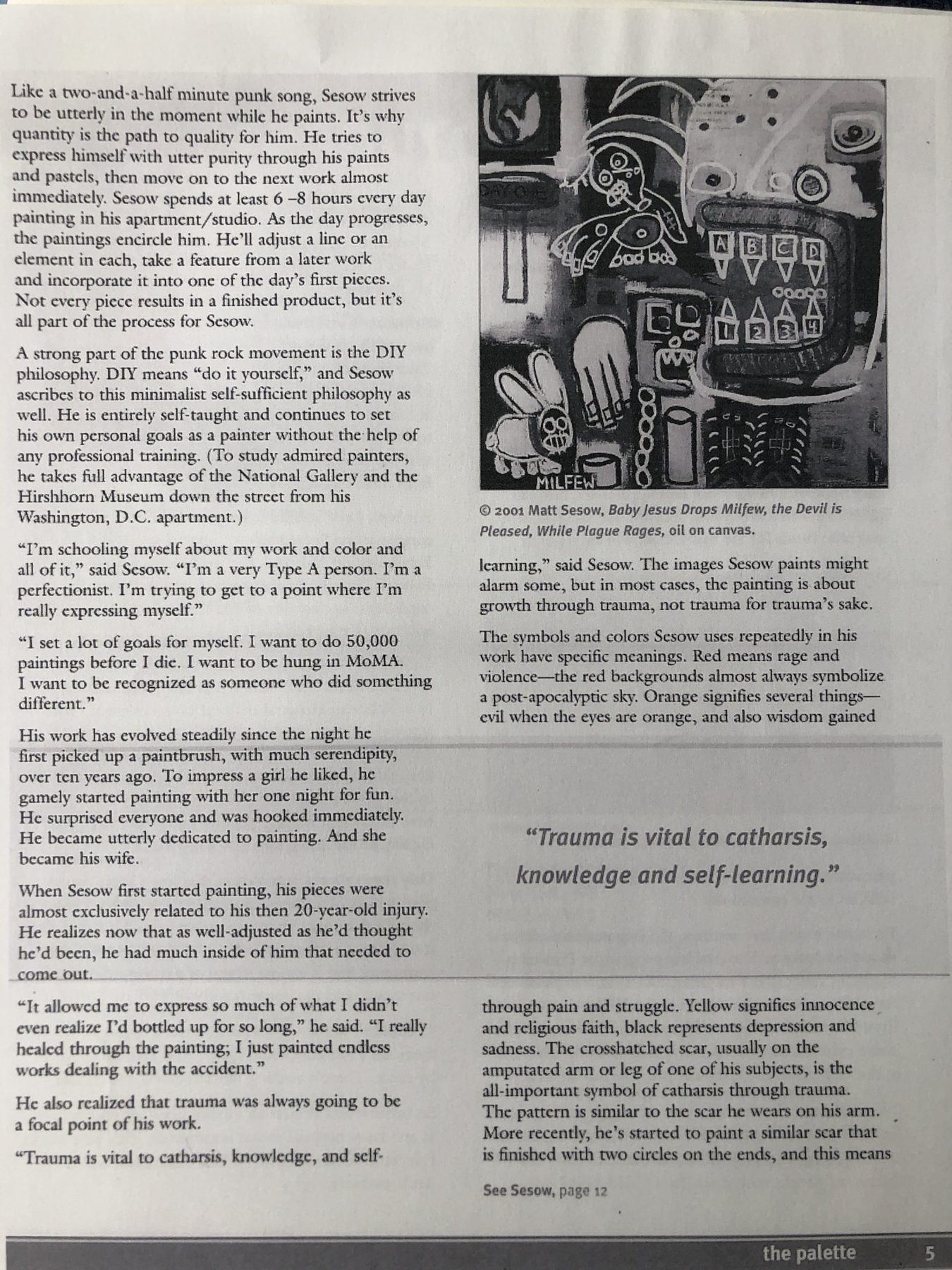
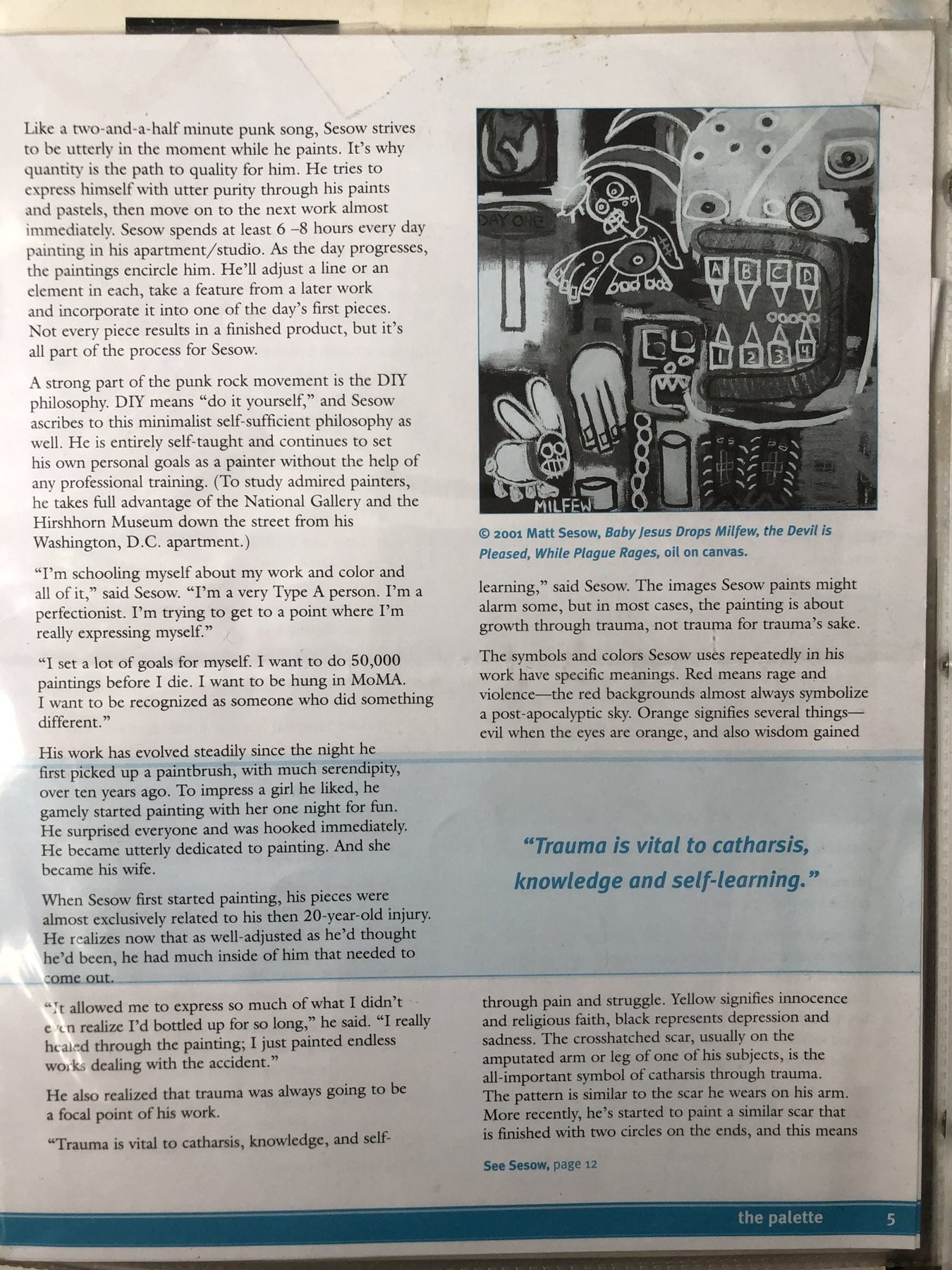
The symbols and colors Sesow uses repeatedly in his work have specific meanings. Red means rage and violence—the red backgrounds almost always symbolize a post-apocalyptic sky. Orange signifies several things—evil when the eyes are orange, and also wisdom gained through pain and struggle. Yellow signifies innocence and religious faith, black represents depression and sadness. The crosshatched scar, usually on the amputated arm or leg of one of his subjects, is the all-important symbol of catharsis through trauma. The pattern is similar to the scar he wears on his arm. More recently, he's started to paint a similar scar that is finished with two circles on the ends, and this means
"Trauma is vital to catharsis, knowledge and self-learning."
[Caption:] © 2001 Matt Sesow, Baby Jesus Drops Milfew, the Devil is Pleased, While Plague Rages, oil on canvas.
See Sesow, page 12
[Page 12] Sesow, continued from page 5
a traumatic experience has occurred but no wisdom was gained. Sesow has developed a spiritual philosophy about the importance of catharsis. True wisdom is unavailable without trauma. Through the healing process of a trauma, Sesow believes we gain valuable knowledge.
This is also why he is such a strong advocate of the hospital shows he takes part in. Even when a hospital in Nebraska returned a work of his that they had bought, he remained positive. (Especially because it was a hospital where his father had been successfully treated.) He is a frequent contributor to the Sunnyview Gallery exhibitions, and emphasizes that every hospital should hang original work, and every hospital patient should be painting.
"We should all be painting," said Sesow. "I have to paint. I'm going to paint my whole life. It gives me the ultimate freedom."
In a stroke of luck, Sesow found an agent very early in his career. (Or perhaps the agent found him. She bought the first piece of work he ever sold.) She marketed him exclusively as an 'outsider/naïve artist,' but Sesow eventually wearied of being pigeonholed as part of a movement, especially one that by its definition limited his growth as an artist and as a professional. He now works without an agent, and is having much success.
He is driven, and takes every opportunity to enlarge his circle of contacts. He is active in arts groups like the Washington Project for the Arts/Corcoran (wpaconline.org), and maximizes the usefulness of his Web site at www.sesow.com.
A former computer engineer, Sesow is comfortable online and keeps the Web site updated daily. He uses an old digital camera to upload countless images of his art. He sells his work from this site, and gives online buyers a complete and total refund if they decide they don't like the work after they receive it.
Sesow spent the Internet boom years leapfrogging from one well-paying job to the next with IBM, Netscape, and AOL, and it allowed him to buy his own studio apartment. This unusual background for an artist gave him something else that most artists can't claim—a certain amount of financial stability.
He doesn't want money to ever motivate his work; he fears what it might do to his inspiration. He has strong opinions about the capitalist nature of this element of his career.
"If you need money, it changes your work," said Sesow. "It's worth working at some odd job so you have that freedom." He is moderate in his pricing, and very flexible. "If someone wants my work, I want them to have it," he said.
A few years ago, Sesow divorced his wife. The experience devastated him, yet gave him a new source of trauma for his work.
The wounds from his divorce have healed considerably, thanks to time and a new love in his life. Without an overwhelming trauma to work through, he sometimes finds inspiration more challenging, although the war in Iraq has provoked many recent works (all with red skies). When desperate for subject matter, he resorts to using the images in "People" magazine. On his canvas, however, "They always end up a little twisted," he said.
"Even when I am using outside sources, the final result is always heavily influenced by what's going on in my brain. It's about 80% me, 20% the outside world."
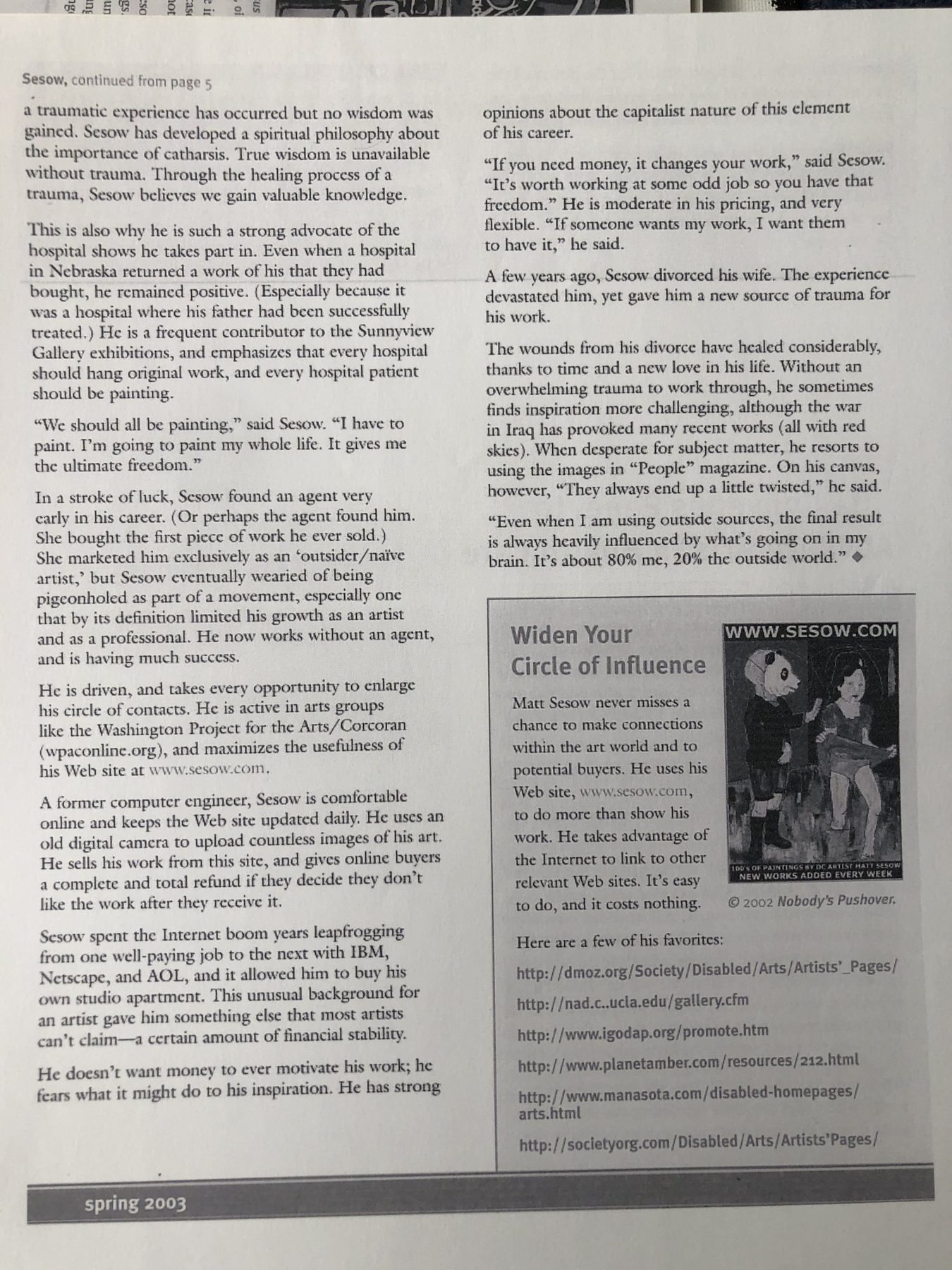
[Sidebar] Widen Your Circle of Influence
Matt Sesow never misses a chance to make connections within the art world and to potential buyers. He uses his Web site, www.sesow.com, to do more than show his work. He takes advantage of the Internet to link to other relevant Web sites. It's easy to do, and it costs nothing.
Here are a few of his favorites:
http://dmoz.org/Society/Disabled/Arts/Artists'_Pages/
http://nad.c..ucla.edu/gallery.cfm
http://www.igodap.org/promote.htm
http://www.planetamber.com/resources/212.html
http://www.manasota.com/disabled-homepages/arts.html
http://societyorg.com/Disabled/Arts/Artists'Pages/
[Image:] WWW.SESOW.COM — 100'S OF PAINTINGS BY DC ARTIST MATT SESOW — NEW WORKS ADDED EVERY WEEK — © 2002 Nobody's Pushover.
Matt Sesow: Extreme DIY
Self-taught artist excels in the art world
"Quality, not quantity." Art teachers perpetually drum this phrase into heads. Artist Matt Sesow disagrees. For him, quantity is the path to quality. He's enormously prolific, and his artistic goals usually include a completion count that can creep into the hundreds.
For instance, he has been accepted into a month-long artist's retreat in Costa Rica this June. His goal isn't to create one or two definitive pieces, or to use the time to complete a longstanding project. He plans to complete 100 works on paper, and 50 on canvas.
Sesow's approach has come with much success. His intense and vibrant artwork has a strong following and the approving gaze of the critical echelon. His popularity is also steadily growing. Last year, he sold 700 of his paintings, 150 of them from his Web site at www.sesow.com. He's exhibited around the country, had a solo show at the Corcoran Gallery of Art in Washington, D.C., and hangs on the walls of some of the country's biggest collectors. Sesow is also a regular contributor to various hospital art shows, including the Sunnyview Gallery in Schenectady, New York (see related story, page 6).
[Pull quote:] "I have to paint. I'm going to paint my whole life. It gives me the ultimate freedom."
"Matt Sesow had us all floored at the opening," said Ruth Daly, curator of the Sunnyview Gallery. "He just came bounding in with all of his enthusiasm, and we already loved his work."
Sesow lost his left hand and forearm in a chance accident when he was 8 years old. He was playing with his siblings and friends when a low-flying propeller plane sheared off his arm. (The children were playing at the end of a landing strip.) Sesow lives without a prosthetic, and he credits his supportive family for helping him to rise above the negatives of the injury.
He also derived strength from the punk music movement. As a teenager, he connected with these so-called outsiders. The raw hardcore energy of the music fuels his inspiration to this day. "They were different, and I was different. I still listen to the same music that I did in high school and college—Fugazi, Hüsker Dü, the Clash, Siouxsee and the Banshees."
As an artist, Sesow brings a punk ethos to his painting, evident in the sharp lines, aggressive, sometimes violent imagery, and frenetic energy of his work. Music is also part of his process and is as vital as the oil paints he uses. He frequently finds himself expressing the emotions that a favorite lyric evokes.
To many who don't listen to punk music regularly, it is probably surprising to discover how multi-layered and multi-emotional this music can be. People exposed to Sesow's work have the same impression.
[Photo caption:] Matt Sesow in his studio with El Bunny, © 2003. (photo: kate damon)
Like a two-and-a-half minute punk song, Sesow strives to be utterly in the moment while he paints. It's why quantity is the path to quality for him. He tries to express himself with utter purity through his paints and pastels, then move on to the next work almost immediately. Sesow spends at least 6–8 hours every day painting in his apartment/studio. As the day progresses, the paintings encircle him. He'll adjust a line or an element in each, take a feature from a later work and incorporate it into one of the day's first pieces. Not every piece results in a finished product, but it's all part of the process for Sesow.
A strong part of the punk rock movement is the DIY philosophy. DIY means "do it yourself," and Sesow ascribes to this minimalist self-sufficient philosophy as well. He is entirely self-taught and continues to set his own personal goals as a painter without the help of any professional training. (To study admired painters, he takes full advantage of the National Gallery and the Hirshhorn Museum down the street from his Washington, D.C. apartment.)
"I'm schooling myself about my work and color and all of it," said Sesow. "I'm a very Type A person. I'm a perfectionist. I'm trying to get to a point where I'm really expressing myself."
"I set a lot of goals for myself. I want to do 50,000 paintings before I die. I want to be hung in MoMA. I want to be recognized as someone who did something different."
His work has evolved steadily since the night he first picked up a paintbrush, with much serendipity, over ten years ago. To impress a girl he liked, he gamely started painting with her one night for fun. He surprised everyone and was hooked immediately. He became utterly dedicated to painting. And she became his wife.
When Sesow first started painting, his pieces were almost exclusively related to his then 20-year-old injury. He realizes now that as well-adjusted as he'd thought he'd been, he had much inside of him that needed to come out.
"It allowed me to express so much of what I didn't even realize I'd bottled up for so long," he said. "I really healed through the painting; I just painted endless works dealing with the accident."
He also realized that trauma was always going to be a focal point of his work.
"Trauma is vital to catharsis, knowledge, and self-learning," said Sesow. The images Sesow paints might alarm some, but in most cases, the painting is about growth through trauma, not trauma for trauma's sake.
[Pull quote:] "Trauma is vital to catharsis, knowledge and self-learning."
The symbols and colors Sesow uses repeatedly in his work have specific meanings. Red means rage and violence—the red backgrounds almost always symbolize a post-apocalyptic sky. Orange signifies several things—evil when the eyes are orange, and also wisdom gained through pain and struggle. Yellow signifies innocence and religious faith, black represents depression and sadness. The crosshatched scar, usually on the amputated arm or leg of one of his subjects, is the all-important symbol of catharsis through trauma. The pattern is similar to the scar he wears on his arm. More recently, he's started to paint a similar scar that is finished with two circles on the ends, and this means
See Sesow, page 12 [continuation page not photographed]
[Image caption:] © 2001 Matt Sesow, Baby Jesus Drops Milfew, the Devil is Pleased, While Plague Rages, oil on canvas.
4 spring 2003 / the palette 5
Pictures · click to enlarge
From the press archive
Where this record comes from
- history.sesow.com (live, 2026-10-03)
- Matt Sesow press packet (photographed by Matt, 2026-10-18)
Cite as: Sesow, Matt. “Interview with ‘The Palette’.” Matt Sesow Career Chronicle, 2003. history.sesow.com/e/2003-interview-palette-publication-vsa-arts.html. Accessed [date].
Were you there? Do you have a photo, a clipping or a memory of this? Please write to sesow@sesow.com or use Ask Matt a question, and it will be added here.
Also in 2003
- Exhibition Southern Ohio Museum, Portsmouth, OH
- Exhibition Mandeville Gallery, Nott Memorial, Union College, Schenectady, NY
- Exhibition UNLV Marjorie Barrick Museum, Las Vegas, NV
- Milestone Launches “31 Days in July” — annual project creating one large painting per day in response to morning news
- Press Washington City Paper on “31 Days in July” (2003)
- Press “…31 days in july…” — Get Underground feature (2003)
- Media The Larz from Mars Show — Matt Sesow, July 2003
- Exhibition “Art Against War,” Grand Atrium, Majlis Cultural Center, Mumbai, India
- Exhibition “Political Bodies,” Seattle, WA
- Exhibition Residency as visiting artist, Ciudad Colon, Costa Rica
- Exhibition Painted set for Hollywood play “F**king Wasps”
- Exhibition B-Side group show — Adams Morgan, Washington, DC
- Exhibition Sesow showing in Lincoln — University Place Art Gallery
- Exhibition Nisk-Art Gallery, Schenectady, NY
- Exhibition Guest Artist — Kentuck Festival
- Award First Place — 2003 Adams Morgan Juried Arts Festival, Washington, DC
- Award Juror’s Choice Award — Viewpoint Gallery, Schenectady, NY
- Press Las Vegas Mercury review compares work to George Grosz, Francis Bacon, and Edvard Munch
- Press David Brickman, “This Is Not the Academy”
- Press Article in “Artesian” Magazine
- Press Compass Magazine — cover and feature article; published by Leonard Cheshire, UK
- Press Coagula Magazine — Los Angeles
- Media Kudzu Wish CD cover — Reverse Hurricane, NC band
- Exhibition The Ottobar, Baltimore, MD — March, over 20 works
- Exhibition Aroma, Cleveland Park, Washington, DC
- Exhibition “A Really Big Show,” Results Gallery with WPA/Corcoran, Washington, DC
- Exhibition “The Art of Conflict,” national juried exhibition, 57 N Fine Art, 1701 Kalorama Road NW, Washington, DC
- Exhibition “POV,” ARTOCONECTO national juried exhibition, 1701 Kalorama Road NW, Washington, DC
- Exhibition OCCOA at CDW Gallery, 30th and M Street, Georgetown, Washington, DC
- Exhibition Kalorama Emerging Artists Fair, 1711 Kalorama Road NW, Washington, DC
- Exhibition “Love and Eroticism,” juried exhibition, Khoja Gallery, Arlington, VA
- Exhibition Capital Region Art Center, Albany, NY
- Exhibition Guest Artist — 10th annual Folk Fest 2003, North Atlanta Trade Center, Atlanta, GA
- Exhibition “March Madness” shown in “Art Against War: An Exhibition of Posters and Multimedia”
- Media Lecture — Calvert Elementary School assembly, Lincoln, Nebraska
- Media Lecture — Niskayuna High School assembly, Niskayuna, NY
- Exhibition Stage backdrops — “F**king Wasps,” Theatre of NOTE, Hollywood, CA
- Press The Warrior — Niskayuna High School newspaper
- Press OutsiderArt.info — online exhibition “Matt Sesow...WAR,” about two dozen anti-war paintings from December 2002
- Media Exit Clov CD cover — painting on the cover of “Starfish,” the 2003 EP by DC band Exit Clov